As a year-end summary, I have documented my current and upcoming art exhibitions and announcements in one blog post. I present them in chronological order.
An Ecology of Line 2025 is an online group exhibition featuring selected works of interdisciplinary artists participating in the collaborative exploration of the Ecology of Line under the creative leadership of Camilla Nelson. Unbundling of lines in ecological contexts dissolves barriers between human and more-than-human organisms and elements. This is my second year working with the group. The diversity of work that we have produced is incredible. Visit the online exhibition.
I have two pieces in this year’s exhibition:
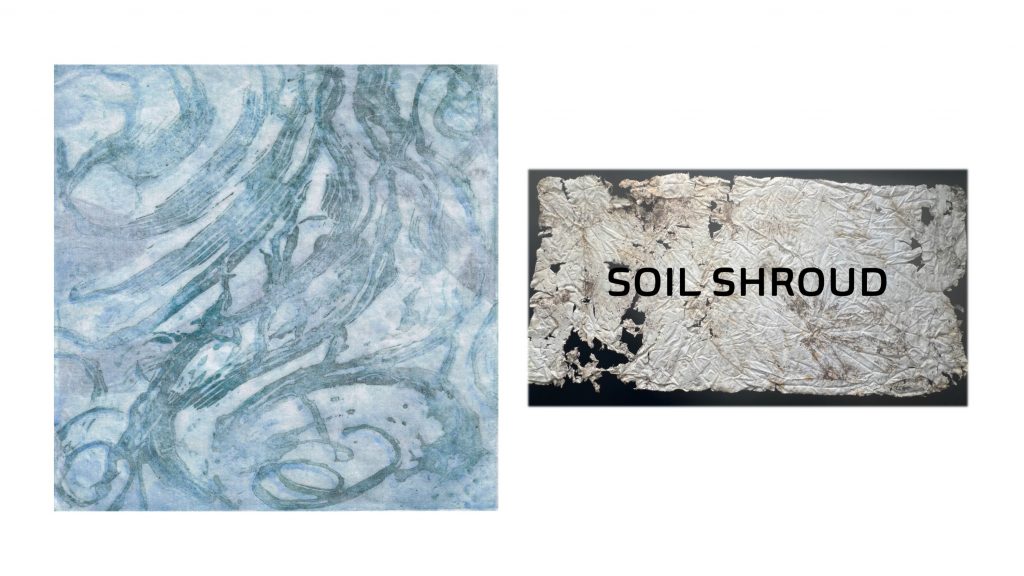
- Beneath is a multi-layered print playing with ideas of presence, absence and trace. American eels are disappearing from former habitats. This increasing absence of presence foreshadows the growing possibility of species extinction – the presence of absence.
- The Soil Shroud is a short video. Using clean white cotton sheets as a metaphoric backdrop, it illustrates a research project that examines the winter bioactivity of the soil at Plot 46. Pristine white cotton cloth becomes both a disturbed and a disturbing surface, and finally a shroud. Click here to watch The Soil Shroud on Youtube.
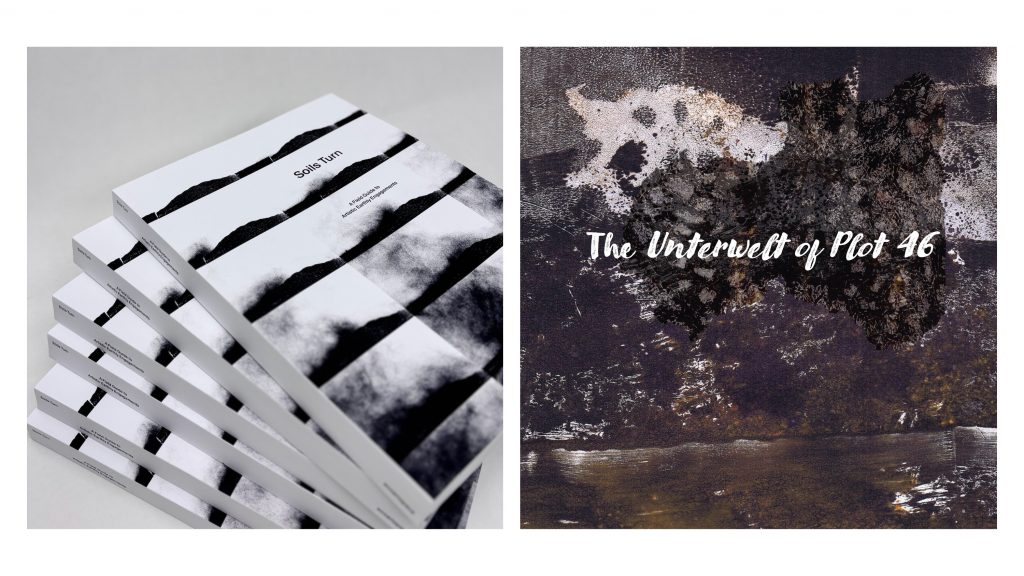
The new ecoartspace book, Soils Turn, serves as a directory to the work of 140 soil artists, working in a variety of interdisciplinary practices. The book is published by ecoartspace with support from Bauhaus-Universität Weimar and was officially launched at Zabriskie, Berlin December 6, 2025. Orders for the second printing can be placed here:
Included in Soils Turn is reference to my video-poem, The Unterwelt of Plot 46.
Plot 46 is my farm allotment where I explore the benefits of regenerative organic agriculture in nurturing the soil and sequestering carbon. Unlike conventional agriculture, which wages war on nature, I raise crops without tilling or the addition of chemicals. In this eco poetic video, I imagine living in the soil and co-mingling with myriad inhabitants of the soil food web. To evoke a sense of “soilness” without literal representation, I incorporate five experimental prints with the spoken poem to embody my “being (in the) soil.”
Click to see The Unterwelt of Plot 46 on YouTube.
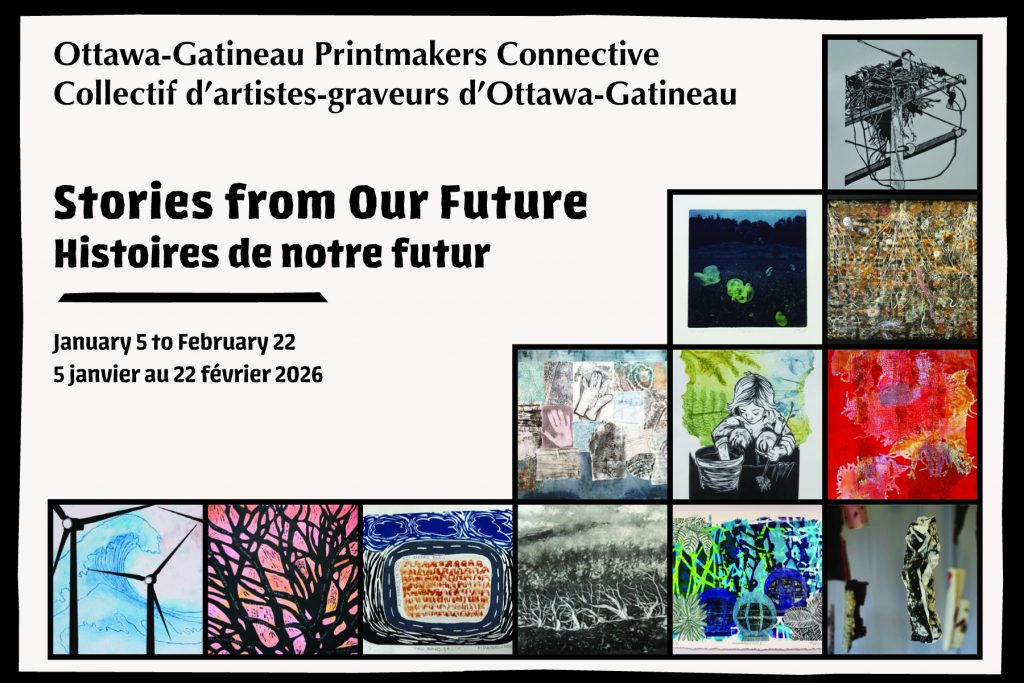
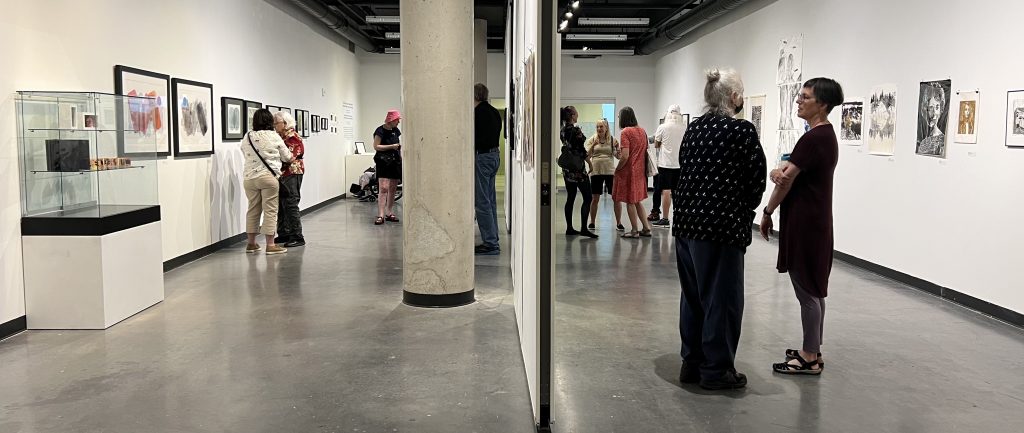
Twenty local printmakers from the Ottawa-Gatineau Printmakers Connective share personal visions of what tomorrow might hold. With cautious optimism tinged with joy, these artists invite visitors to reflect on their own history and their vision of the future, knowing that today’s choices shape tomorrow.
My Story of the Future – Organic Vegan Regenerative Agriculture
I am telling the story of a future where adopting widescale organic vegan regenerative agriculture can reduce greenhouse gas emissions and increase food security in a warming world. I see a future with many small and medium-sized regenerative organic farms around Canadian cities, where incubator farms train immigrants and young Canadians wishing to take up agriculture as a proud profession, and together we produce sufficient, healthy, wholesome plant-based food for all.
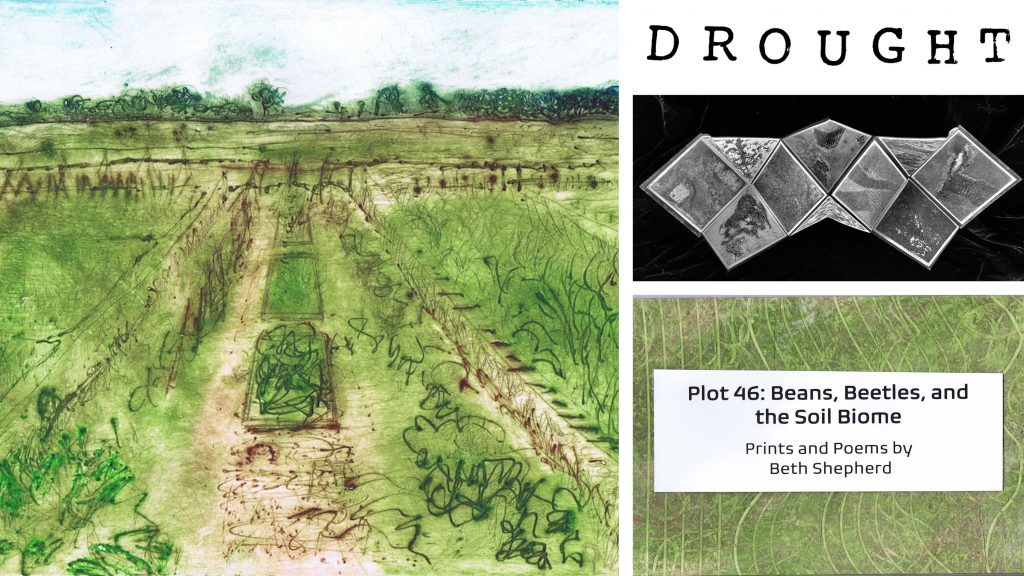
I began Plot 46, a field-based art-research project at the Maple Hill Urban Farm in 2022. In the first year, I focused on the human perspective of the agricultural landscape, as depicted in Pastoral Landscape (State IV) – Summer, a drypoint print that is part of a series of prints depicting the pastoral landscape changing through the seasons.Next is the vegetative zone of my plot, where beans climb poles, sunflowers tower overhead, and beetles cohabit the space. This is represented in the two books included in the show.
- Plot 46: Beans, Beetles, and the Soil Biome, an edition of three hand-bound books, represents a culmination of work undertaken in four growing seasons at Maple Hill Urban Farm. To make the book more accessible, I have created a “flip book” version on Youtube
- DROUGHT, a set of six 4×4 inch “explosion” books, each with ten unique collagraph prints, depict what appears to be aerial views of drought-spoilt land. Climate change is likely to lead to more extreme weather, higher temperatures, and long term drought which will affect food production. For more information see the accompanying essay about drought.
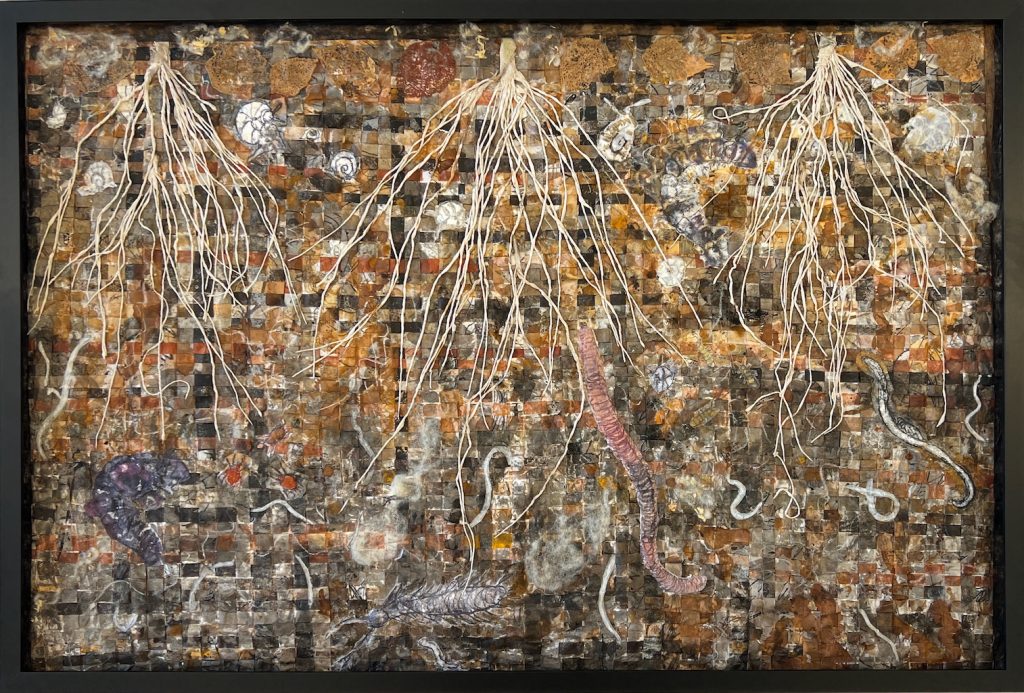
Finally, I struggled to imagine life in the soil biome. With a nod to 18th Century natural history tableaus, the Soil Food Web Tableau depicts an artist’s imagined life below ground at Plot 46. The woven print strips provide the stage for the drama of the soil food web, an assemblage of collagraph and trace monotype prints with other organic and inorganic elements. To learn more about the development of this piece, click here.
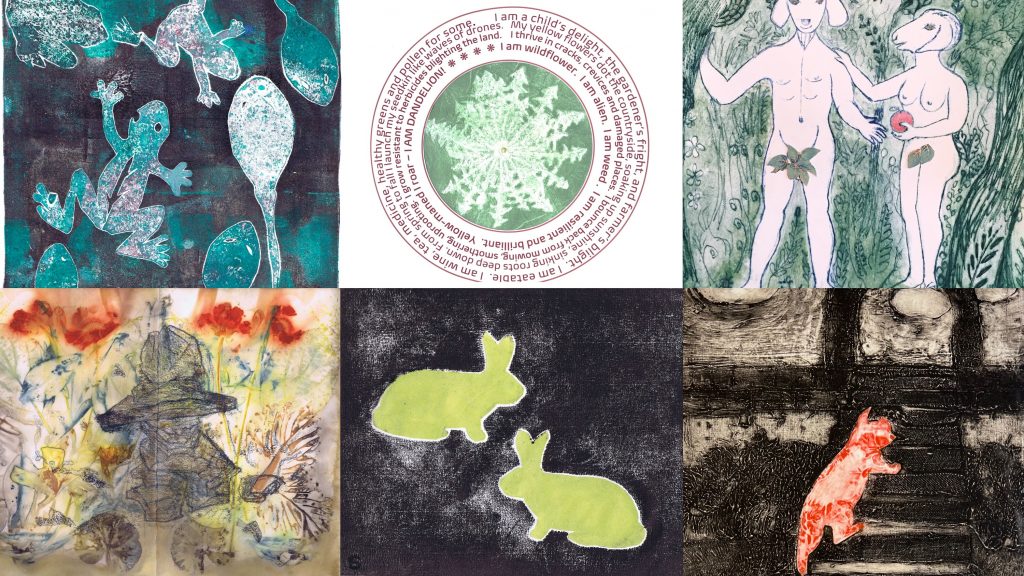
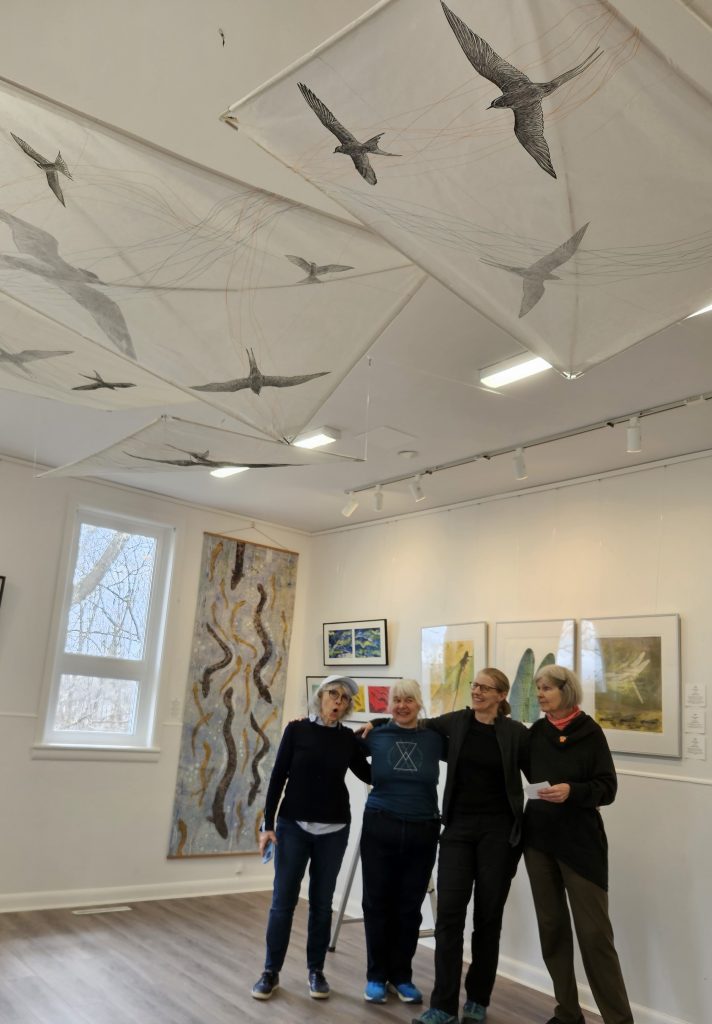
Imaginarium is a group exhibition of works by Don Monet, Debra Percival, Beth Shepherd and Sarah Wayne, where memory, myth, and whimsy collide. Each work offers a doorway into a world just slightly askew from our own where imagination reshapes the everyday.
Drawing from across my printmaking career, I have selected six pieces that together create an imagined garden to brighten the walls of the Stafford Studio throughout the winter months:
- In Stairway to Heaven (Collagraph, 2013) I imagine intelligent pigs striving for a better life on a classic garden monument.
- In In the Garden (etching, 2015), I picture a hybrid Adam & Eve in the style of the great printmaker, Albrect Dürer.
- In Frogs Frogs Frogs (Pochoir print, 2021), I visualize colourful frogs in a garden pond.
- Fluorescent Bunnies (Pochoir print, 2021) is a nod to Eduardo Kac’s 2000 GFP Bunny, a transgenic living artwork named Alba. I imagine two little bunnies crouching timorously now visible in the dark.
- Garden inukshuk (trace monotype on eco print, 2022) depicts my hand-constructed garden sculpture printed on eco paper coloured with local plant material.
- Finally, Think Like a Dandelion (Botanical monotype print with text, 2025), completed for this show, gives voice to the ubiquitous dandelion.
If you want to join me in the garden, please email beth@bethshepherd.ca to arrange a visit.
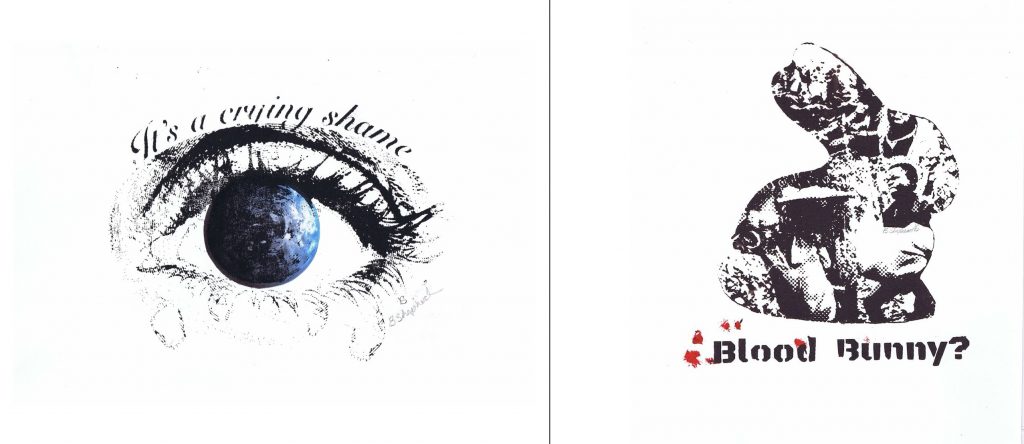
For the Connective Gallery’s first show in 2025 we have selected the theme of “Protest in Print.” For centuries, printmaking has been an important tool for communications and protest. Although much of my work has an element of protest, my PolitArts series that I undertook in 2018 is the most politically overt, tacking a number of difficult issues in the human and more-than-human world. I submitted two PolitArts:
- “It’s a Crying Shame” (Screenprint with collage) laments the sad state of our beautiful blue planet with acidified and warming oceans, melting glaciers, shortages of fresh clean water, over harvesting of marine life, and plastic and chemical pollution everywhere. The crying eye is screen-printed over a photo of the Earth taken from space in 1972.
- Blood Bunny (screenprint) reminds people that children may be harmed along the supply chain of holiday chocolate. After decades of pledging to end child labour, big chocolate makers still purchase much of their commodity cocoa from poor West African countries. These large buyers exert pressure to keep cocoa prices low, which leads to the use of cheap child labour working under dangerous conditions.
Check out the activities of Ottawa-Gatineau Printmakers Connective and the Connective Gallery here.